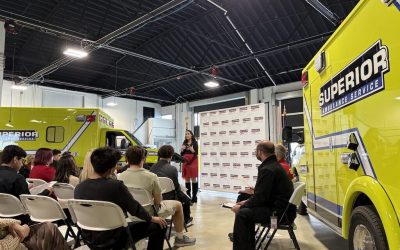
MILWAUKEE, WI – Superior Air-Ground Ambulance Service of Wisconsin has been awarded nearly $210,000 by the Wisconsin Department of Workforce Development (DWD) to train and certify 100 unemployed Wisconsinites for careers as Emergency Medical Technicians (EMTs). In partnership with its affiliate, Life Support Training Institute (LSTI), Superior will use the grant to open new pathways into the EMS field while helping to expand Wisconsin’s frontline healthcare workforce.
The funding is part of the Wisconsin Fast Forward program’s latest $2.3 million investment, supporting training for over 1,000 workers across 18 employers in industries including healthcare, manufacturing, construction, transportation, and customer service. The program focuses on empowering unemployed, underemployed, and current workers to earn recognized credentials, improve career mobility, and secure higher wages.
“Like many states, Wisconsin is facing a critical shortage of trained EMS professionals, and we’re grateful to Governor Evers and DWD Secretary Pechacek for investing in the future of Wisconsin’s EMS workforce,” said Kimberly Godden, Vice President of Superior Air-Ground Ambulance Service. “By empowering Superior Ambulance to expand training pathways for those pursuing new or second careers, this funding will help us equip more people with the skills needed to serve Wisconsin communities in these critical, life-saving roles.”
As the only ambulance provider to receive funding this grant round, Superior’s award underscores its longstanding commitment to creating career opportunities in the communities it serves. And the funding comes at a crucial time: according to the Wisconsin Office of Rural Health, 41% of EMS agencies in the state have experienced staffing shortages severe enough to delay or prevent ambulance response.
“Timely ambulance access ensures patients receive targeted care where it can do the greatest good, especially those requiring rapid response,” said Joe Posey, General Manager of Superior Air-Ground Ambulance Service of Wisconsin. “This grant expands our ability to offer EMT training classes across our 14 stations statewide and helps us to provide meaningful employment to serve our partnerships with healthcare systems assuring their patients receive quality ambulance transports.”
Since its launch in 2013, the Wisconsin Fast Forward program has invested more than $51 million in workforce development across the state, supporting 461 training projects and benefiting over 30,000 workers. Grant recipients are held to strong outcome benchmarks, including a minimum 85% program completion rate, 65% job placement or advancement, and 75% of incumbent workers receiving wage increases.
To learn more about EMT training opportunities through LSTI, visit: www.superiorambulance.com/emt-classes/.